Key Takeaways
- Before pursuing practice ownership, dentists need to decide whether they’re ready to manage a business, not just treat patients.
- Strong credit, manageable personal debt, and adequate cash reserves can help position dentists for financing, whether they’re starting or acquiring a practice.
- Some dental-specific lenders offer 100% financing for startups and acquisitions, but loan terms and requirements vary.
- When buying an existing practice, profitability, historical collections, and the buyer’s ability to maintain production matter more than projected potential.
- Working capital is essential for startups, particularly to cover payroll, operating expenses, and marketing while patient volume and collections grow.
- Choosing between a startup and an acquisition requires evaluating more than cost, including patient retention, staff, equipment, location, and practice culture.
Opening your own dental practice is an exciting milestone, but getting there requires more than clinical skills and a willingness to take on debt. From understanding what lenders look for to deciding whether to buy an existing practice or start from scratch, the financial decisions dentists make early can have a lasting impact on their success.
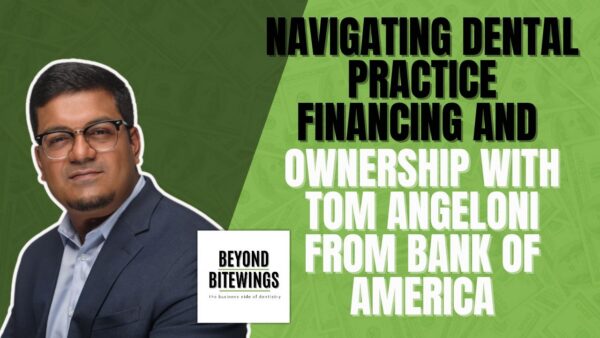
In this episode of Beyond Bitewings, Ash spoke with Tom Angeloni of Bank of America’s Practice Solutions division about financing dental practice ownership. Recorded at the Southwest Dental Conference, their conversation covered how dentists can prepare for financing, common mistakes to avoid, and what to consider before making one of the biggest investments of their careers.
Getting Financially Ready for Practice Ownership
Before applying for financing, Tom encourages dentists to consider whether they truly want to own a business. Practice owners aren’t just clinicians. They’re also responsible for managing employees, overseeing finances, making operational decisions, and building a sustainable business.
For recent graduates, he generally recommends spending at least a year working as an associate to improve clinical efficiency, develop patient communication skills, and learn how a practice operates.
During that time, dentists can also strengthen their financial position. Tom identified several priorities, including maintaining a credit score around 700 or higher, making debt payments on time, avoiding excessive personal spending, and building cash reserves.
One common misconception is that dentists should aggressively pay down student loans before pursuing ownership. While managing debt is important, Tom cautioned against sacrificing liquidity to do so. Lenders want borrowers to have a financial safety net, and using all available cash to eliminate student debt can work against that goal.
As a general guideline, he suggested having cash reserves equivalent to approximately 10% of the requested loan amount, although individual lending requirements vary.
Understanding Startup and Acquisition Financing
One encouraging point for prospective owners is that a substantial down payment isn’t always required.
Tom explained that Bank of America and other dental-specific lenders may offer 100% financing for practice startups and acquisitions. A startup involving the purchase of real estate, however, generally requires a down payment.
The lending considerations differ depending on which path a dentist chooses. For acquisitions, lenders evaluate the practice’s financial performance alongside the buyer’s ability to maintain its production. If a dentist wants to purchase a practice collecting $1 million annually but has never personally produced more than $700,000, that difference may raise concerns.
Tom also emphasized that high collections don’t necessarily mean high profitability. A practice generating $1 million annually can still be a poor investment if overhead consumes most of its revenue.
Buyers should examine several years of financial performance, understand the procedures generating revenue, and assess whether they have the clinical skills to maintain that production.
Just as importantly, they shouldn’t pay a premium based on what a seller claims the practice could produce. Lenders generally base financing decisions on documented historical performance, not hypothetical growth opportunities.
Why Working Capital Matters So Much
For dentists starting a practice from scratch, working capital can be just as important as the money used for construction and equipment.
Tom noted that startup costs commonly reach $800,000 to $900,000, including working capital. New practices need sufficient funds to cover operating expenses while building a patient base and waiting for insurance reimbursements, which can take several months to begin arriving consistently.
Those expenses include payroll, rent, supplies, and an often-underestimated cost: marketing. Opening the doors doesn’t automatically bring patients into the practice. New owners need resources to attract patients, establish referral relationships, and generate the revenue necessary to support operations.
Tom encouraged dentists to ask prospective lenders whether their working capital financing includes restrictions on soft costs, such as marketing. Some lenders limit how borrowed funds can be used, which can create problems when a practice needs money for expenses that don’t involve purchasing physical assets.
He also cautioned against spending too much on equipment before patient demand justifies it. Rather than equipping every available operatory, he generally recommends starting with two or three and expanding as patient volume grows.
The goal is to preserve cash and avoid paying for equipment that isn’t yet generating revenue.
Buying a Practice Isn’t Always the Easier Option
An acquisition can offer significant advantages over a startup, including an existing patient base, employees, equipment, and revenue from day one. But Tom warned against assuming that buying an established practice automatically means a smooth transition.
Patient retention is one concern. If the selling dentist leaves immediately, longtime patients may decide to seek care elsewhere. Tom suggested that having the seller remain involved for six months to a year can help patients become comfortable with the new owner and reduce potential attrition.
Existing employees and practice culture also deserve careful consideration. A buyer may inherit a team accustomed to operating a certain way, equipment that needs replacing, or clinical philosophies that don’t align with their own.
On the other hand, a startup allows dentists to choose their equipment, build their team, and establish their preferred culture from the beginning. That flexibility comes with the challenge of attracting patients and generating enough revenue to cover expenses.
Neither option is inherently better. The right decision depends on the individual dentist, the available opportunities, and the financial and operational realities of each situation.
Location and the Value of Experienced Advisors
Location is another decision that deserves careful research, especially for startups. Tom recommends obtaining a demographic report to understand the number of competing dentists, the surrounding patient population, and whether the market can support another practice.
He also encourages dentists to consider their personal lives when choosing where to establish a practice. Finding an attractive business opportunity is important, but so is choosing a community where they want to live and build their future.
Throughout the conversation, Tom returned to the importance of working with professionals who understand dentistry. Dental-specific lenders, CPAs, contractors, real estate professionals, and other advisors bring experience that can help owners avoid expensive mistakes.
A contractor familiar with commercial buildings, for example, may not understand the specialized plumbing, equipment, and infrastructure required in a dental office. Similarly, a CPA who understands tax law but doesn’t regularly work with dental practices may overlook important financial and operational considerations.
Planning Ahead Makes a Difference
One of Tom’s final recommendations was to begin conversations with lenders and advisors well before you’re ready to purchase or open a practice. Even dentists who are two or three years away from ownership can benefit from understanding financing requirements, building cash reserves, managing debt, and evaluating potential opportunities.
Practice ownership is a major financial commitment, and the right preparation can make the transition considerably smoother. Whether you’re buying an established practice or building one from the ground up, the objective isn’t simply to qualify for financing. It’s to make decisions that support a profitable, sustainable practice for years to come.
At Edwards & Associates, we work exclusively with dental professionals, helping them evaluate practice opportunities, understand the financial implications of ownership, and plan for long-term success. If you’re considering purchasing or starting a practice, contact our team to discuss your plans before making your next move.
 Listen Now!